
Have you ever felt that you explained something as clearly as possible, only to find that your colleague understood it differently? Or have you ever met someone who seems so easy to talk to, while communicating with someone else feels like it takes much more effort?
These situations are quite common in the workplace. Everyone has a different way of sharing information, making decisions, responding to situations, and building relationships with others.
These differences can make communication challenging. A message that feels clear to one person may not be as easy for someone else to understand.
Yet, communication plays an important role in building collaboration, aligning work, and creating positive professional relationships.
So, how can we understand different communication styles and adjust our approach to make our messages more effective?
Why Is Effective Communication Important in the Workplace?
Communication is more than simply transferring information from one person to another. In the workplace, it also helps build shared understanding, coordinate activities, and maintain relationships between individuals and teams.
In Communication in Organizations, published in the Annual Review of Organizational Psychology and Organizational Behavior, Joann Keyton explains that organizational communication encompasses various perspectives, ranging from individual interactions to communication within groups and organizations as a whole.
This highlights the broad role of communication in professional life, including how people understand information, interact with colleagues, and carry out their responsibilities.
Learn more about organizational communication through Annual Reviews.
One of the challenges of workplace communication is that people process information differently.
For example, some people may prefer receiving information in a concise, direct, and results-oriented manner. Others may need a more structured explanation, time to process information, or an opportunity to discuss it first.
When these differences are not understood, communication can lead to misunderstandings, discomfort, and even affect work processes.
On the other hand, understanding other people’s communication needs can help us deliver messages more appropriately.
Communication Is Not Just About Speaking, but Also Listening
Effective communication requires the ability to deliver a message while also understanding another person’s perspective.
Research published in the Annual Review of Organizational Psychology and Organizational Behavior, titled The Power of Listening at Work, discusses the importance of listening in professional settings.
The review highlights how listening contributes to better understanding and more effective interactions in the workplace.
The Power of Listening at Work – Annual Reviews.
Therefore, effective communication is not only about how clearly someone speaks, but also about their ability to understand the needs, responses, and ways others receive information.
Good communication is not only about what we say, but also about how we understand others.
Talk to Anyone: Understanding Different Communication Styles
One approach to understanding communication differences is through behavioral style models that help identify how people tend to interact.
The DISC model, for example, uses four behavioral dimensions: Dominance, Influence, Steadiness, and Conscientiousness.
This model provides a framework for discussing differences in how people approach challenges, influence others, manage their pace, and respond to rules or procedures.
However, it is important to understand that communication styles are not labels that define someone’s entire personality. Each individual may demonstrate a combination of different tendencies depending on the situation and their work requirements.
Understanding the DISC Model – Everything DiSC.
In the Talk to Anyone: Know Your Communication Color training material, this approach is introduced through four Communication Colors: Red, Yellow, Green, and Blue.
Each color represents a different communication tendency, ranging from a focus on results and interaction to stability, logic, and structure.
Understanding these four styles can help us recognize that everyone has different communication needs.
1. Red: Power & Results
The Red communication style tends to focus on results, assertiveness, and quick decision-making.
Individuals with this tendency generally prefer communication that is direct, clear, and efficient. They want to know what needs to be done, the expected outcome, and what decisions are required.
In the training material, Red is described as having strong drive and a high focus on results, but relatively less patience for lengthy explanations.
How to communicate with Red:
- Deliver information directly and clearly.
- Put the main point or result first.
- Provide concrete options and recommendations.
- Explain the required action and deadline.
- Avoid lengthy small talk and irrelevant process details.
Example:
“The results are ready. There are two options, and I recommend option B. I need your decision before 3 PM.”
This approach helps deliver the message concisely while providing the information needed for decision-making.
2. Yellow: Fun & Connection
Yellow tends to have a more expressive, enthusiastic, and interaction-oriented communication style.
This style enjoys warm communication, opportunities to exchange ideas, and conversations that create connections with others.
In the training material, Yellow is described as having high energy, creativity, and optimism. However, conversations may sometimes move in different directions, making it important to maintain focus on the original topic or objective.
How to communicate with Yellow:
- Start the conversation with a warm greeting.
- Show enthusiasm and a positive response.
- Give them opportunities to share ideas.
- Build interaction before moving into technical discussions.
- Avoid communication that feels too rigid or direct without context.
Example:
“Hi! I have an exciting idea for next month’s promotion. Can I share it with you for a moment?”
With a more interactive approach, communication can feel more comfortable and create opportunities for discussion.
3. Green: Peace & Stability
Green tends to have a calm, supportive, and harmony-oriented communication style.
This style generally values stable relationships, communication that does not feel rushed, and opportunities to understand a situation before making decisions.
In the training material, Green is described as having strong patience and reliability. They also tend to consider other people’s circumstances and maintain team harmony.
How to communicate with Green:
- Use a calm tone of voice.
- Give them time to understand the information.
- Explain changes in plans in advance.
- Listen to their responses and consider their needs.
- Avoid putting excessive pressure on them to make sudden decisions.
Example:
“There is a schedule change for next week. I’m letting you know in advance so you have time to adjust.”
This approach helps create more supportive communication while giving others room to prepare.
4. Blue: Logic & Structure
Blue tends to have a communication style that focuses on logic, accuracy, and structure.
This style values clear information, verifiable data, and explanations presented systematically.
In the training material, Blue is described as having strong attention to detail and planning. They generally want to understand the basis of information before making decisions.
How to communicate with Blue:
- Present information in a logical sequence.
- Use relevant data and facts.
- Explain the information sources and calculations.
- Allow time to review the information.
- Avoid overly emotional or scattered communication.
Example:
“Here is the sales data for each branch, along with the calculation method. Please review it before we make a decision.”
By providing structured information, communication can create clearer understanding and support the decision-making process.
How Can We Adapt Our Communication Style to Others?
Understanding the four Communication Colors is the first step. The next challenge is applying them in everyday interactions.
Effective communication does not mean that we have to change our personality or completely alter the way we speak.
Instead, we can adjust our communication approach based on the needs of the person we are talking to.
Here are three practical steps to apply.
1. Observe: Pay Attention to How Others Communicate
Notice how someone delivers messages, chooses their words, responds to information, and makes decisions.
Do they prefer information that gets straight to the point? Do they need room for discussion? Or are they more comfortable when information is presented in a structured way?
Observing communication patterns can help us understand which approach may be more suitable.
However, avoid labeling someone based on a single conversation. Consider the context and their behavior first.
2. Adjust: Adapt the Way We Deliver Our Message
Once we understand another person’s communication needs, we can adjust our approach without changing the core message.
If someone needs concise information, present the main point first.
If someone needs interaction, give them room to discuss.
If someone needs time to process information, avoid rushing them into making a decision.
Meanwhile, if someone needs data, make sure the information provided is complete and verifiable.
These simple adjustments can make communication feel more relevant and easier to understand.
3. Check: Make Sure the Message Is Understood
Communication does not end when the message has been delivered.
Make sure the information received is aligned with what we intended to communicate.
We can do this by asking simple questions such as:
“Is the information clear enough?”
“So, what we have agreed on is this, right?”
“Is there anything I need to explain further?”
This step helps reduce potential misunderstandings and gives both parties an opportunity to align their understanding.
Observe, Adjust, Check is a simple approach to building more adaptive communication.
It is not always other people who need to adjust to us. Sometimes, we also need to adapt the way we communicate so our messages can be received more effectively.
Borwita’s Sharing is Caring: Talk to Anyone – Know Your Communication Color
Understanding communication styles is one of the skills that can help build more positive workplace relationships.
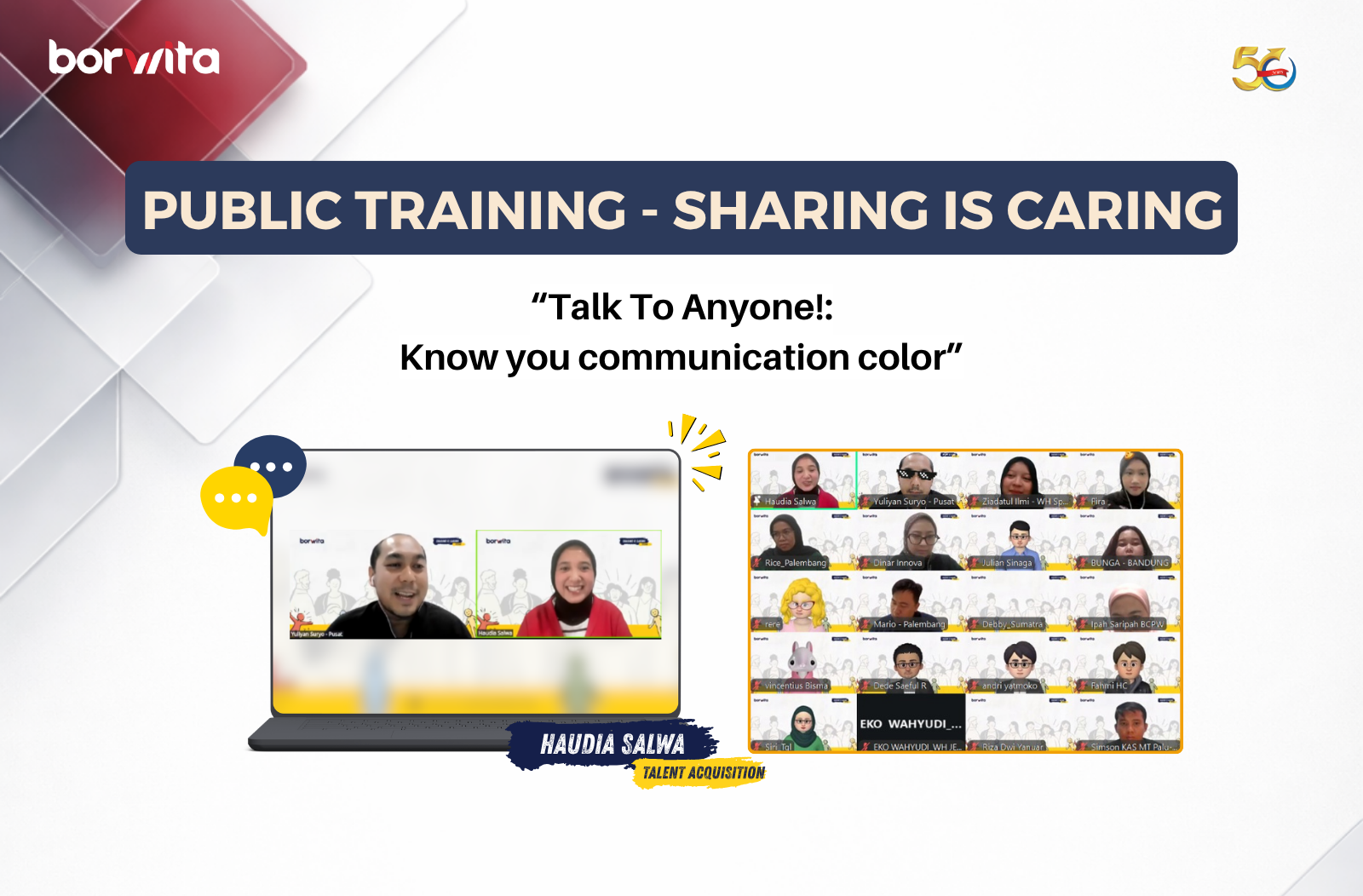
To support the development of this capability, Borwita introduced Public Training – Sharing is Caring: Talk to Anyone – Know Your Communication Color as part of its Personal Development Series.
The session was held on Thursday, October 15, 2026, online via Zoom, featuring Haudja Salwa El Laili, Talent Acquisition & Employer Branding Specialist, as the speaker.
Through this session, Borwita Learners were invited to recognize four different communication styles, understand the needs of each style when receiving information, and learn how to adjust their communication approach to deliver messages more effectively.
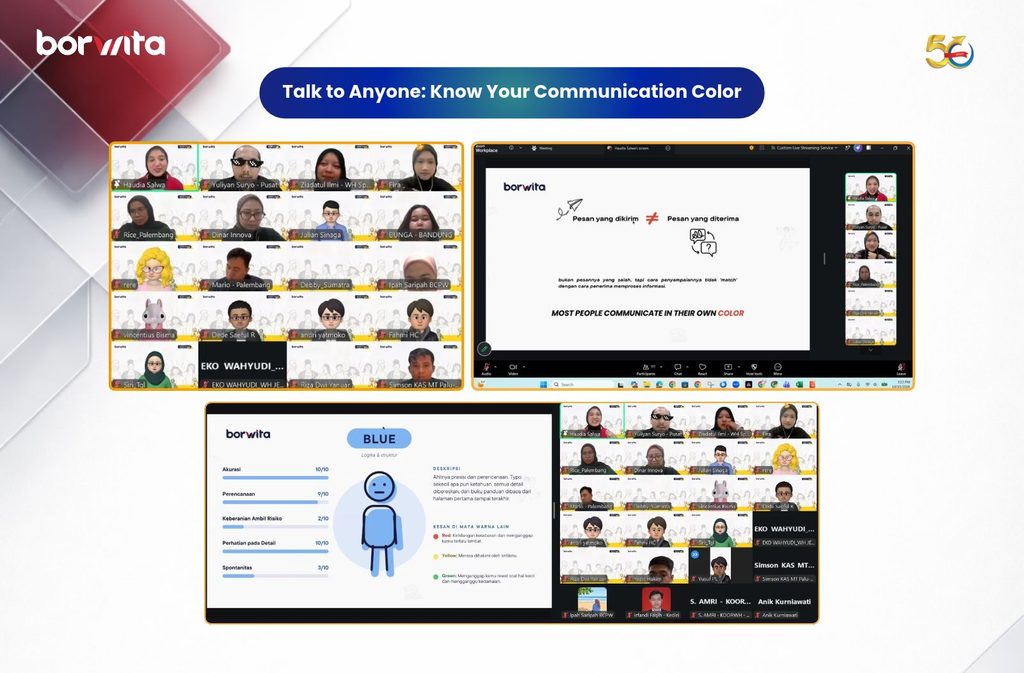
Recognizing Communication Colors and Their Needs
During the training session, participants explored the characteristics of Red, Yellow, Green, and Blue through communication examples that reflect everyday workplace situations.
The learning experience focused not only on recognizing each color’s characteristics, but also on understanding how different communication styles influence the way people receive messages.
Participants learned communication approaches suited to each color’s needs, from delivering information directly and building warm interactions to allowing time to process messages and presenting data in a structured manner.
By understanding these needs, participants were expected to become more comfortable adjusting their communication approaches when interacting with colleagues.
Learning Through Workplace Communication Scenarios
One of the interesting parts of the session was an interactive activity that encouraged participants to identify Communication Colors through examples of messages commonly found in the workplace.
Participants were invited to read messages from different situations and identify communication tendencies based on word choice, tone, and the way information was delivered.
For example, a message from a branch Sales colleague inviting the team to discuss a gathering idea could indicate a Yellow tendency through its enthusiastic greeting, creative idea, and invitation to interact.
Meanwhile, a message from a Finance colleague requesting number verification, data sources, and calculation methods could indicate a Blue tendency through its attention to detail and need for accurate information.
Through this activity, participants learned not only to recognize different communication styles, but also to respond in ways that better suit their needs.
This learning experience helped participants understand that the same message may require a different approach depending on the communication needs of the recipient.
Building More Adaptive Communication
At the end of the session, participants were encouraged to understand that everyone has a unique communication style.
These differences should not be viewed as obstacles, but rather as opportunities to build better understanding.
By observing how others communicate, adjusting our approach, and ensuring that messages are understood, we can create more effective interactions.
Through Sharing is Caring, Borwita continues to encourage the development of interpersonal skills that support collaboration, communication, and more positive workplace relationships.
Better Communication Starts with Understanding Others
Everyone has a different way of delivering and receiving information.
Some people feel more comfortable with direct communication, others prefer interaction, some value calmness, while others prioritize data and structure.
Understanding these differences helps us recognize that effective communication is not only about delivering messages well, but also about understanding how others receive and process information.
Through the Observe, Adjust, Check approach, we can begin building more adaptive communication in different workplace situations.
Because ultimately, they are not strange or difficult people to communicate with. They may simply have a different way of communicating.
And when we begin to understand these differences, we can build better workplace relationships, create more positive collaboration, and deliver messages more effectively.
Through various employee development programs, Borwita continues to support Borwita Learners in learning, growing, and developing capabilities that are relevant to the workplace.
Because good communication is not just about talking to anyone, but also about understanding how to connect with everyone.